30 AI Systems 
Get the eBook
2026 Edition

30 AI Systems You Can Build Without Coding

A plain-English playbook for small business owners, freelancers, marketers and solopreneurs.

Turn repetitive business tasks into practical AI-powered workflows — without learning to code.
Get the eBook — $9.99
Instant digital access after payment
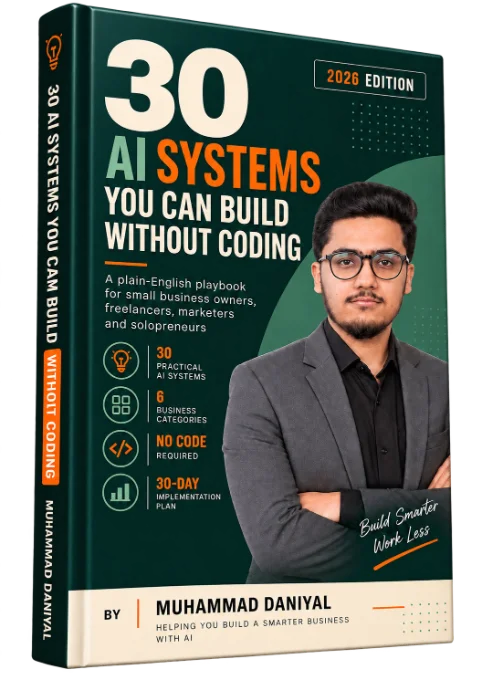
30 AI Systems You Can Build Without Coding — eBook cover

You already use AI. But are you actually using it as a system?

Repeating the same tasks every week, by hand, every time.
Manually answering the same customer questions over and over.
Forgetting to follow up on sales enquiries and quotes.
Spending too much time writing repetitive emails.
Turning meeting notes into tasks by hand, if at all.
Struggling to post content consistently.
Drowning in repetitive administrative work.
Knowing AI is powerful, but not knowing how to connect it to a real workflow.
The Big Idea

An AI system is TRIGGER → AI STEP → ACTION

TRIGGER
New lead
→
AI STEP
AI understands the request
→
ACTION
Personalized reply + notification

The book teaches you to turn a repeated task into a small chain of steps that runs on its own — so you stop rewriting the same reply, and start building something that works while you're not there.

What's Inside

Everything you need to build your first system

30 practical AI systems
Real workflows for support, sales, marketing, admin, knowledge and personal use.
Step-by-step build instructions
Six numbered steps to build each system, start to finish.
Tools to try
Named starting points for every system, with honest notes on tradeoffs.
Starter prompts
Copy-and-edit prompts with [square brackets] for your own details.
Effort ratings
Every system marked Easy or Medium, so you know what you're signing up for.
"Best for" guidance
Who each system suits, so you can find yours fast.
Common problems
The real, everyday pain each system is built to solve.
Watch-out-for notes
Safety and implementation notes for every single system.
30-day implementation plan
A week-by-week plan to choose, build, test and measure one system.
Quick-reference guide
All 30 systems, effort and best-for, on two pages.
Glossary and sources
Plain-English definitions and the sources behind the book.
The Full List

30 systems, organized in six groups

You don't need to build all 30. Pick the one that fixes the thing that annoys you most every week.

Inside Every System Page

Not theory. A build guide.

01
The problem
What this system actually solves, in plain terms.
02
Who it's for
The type of business or role that benefits most.
03
Tools to try
Named tools to get started, no research required.
04
How it works
The trigger, the AI step and the action, laid out simply.
05
Build it step by step
Six numbered steps from zero to a working system.
06
Starter prompt
A copy-and-edit prompt with brackets for your details.
07
What to watch out for
The specific risks and mistakes to avoid with this system.

No developer. No programming course. No complicated coding.

"If you can fill in a form and follow a recipe, you can build these."

The book is written for non-technical people, using commonly available no-code and AI tools. Every system is rated Easy (one main tool, often an afternoon) or Medium (two or three tools connected, often a weekend) — so you always know what you're signing up for.

Start with an Easy system. The effort ratings make it easy to choose a starting point that fits your time and comfort level.

A Look Inside

Real pages from the book

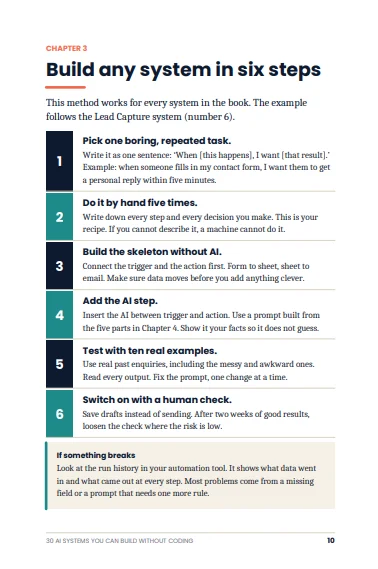
Book page 10 — Build any system in six steps
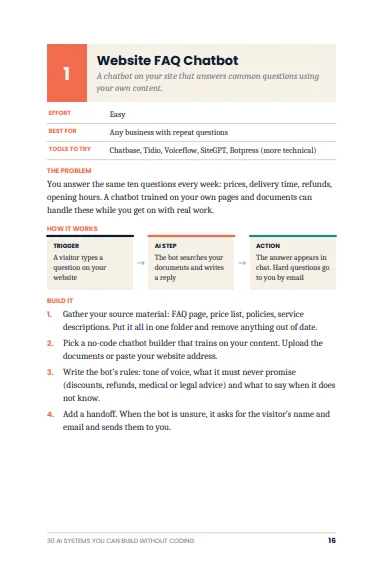
Book page 16 — Website FAQ Chatbot
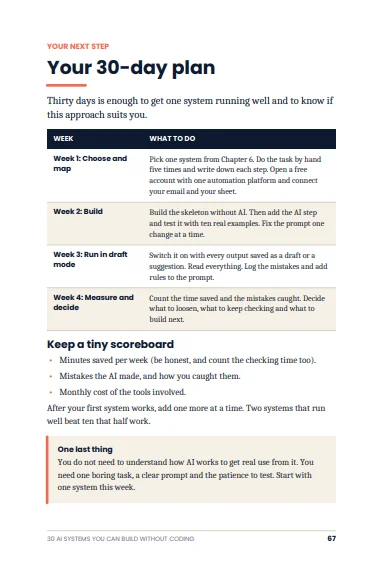
Book page 67 — Your 30-day plan
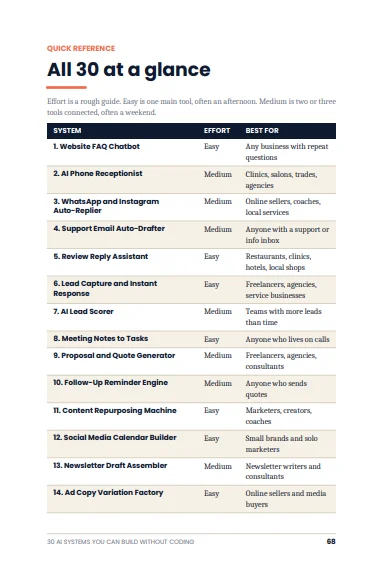
Book page 68 — All 30 at a glance
Your Next Step

A 30-day plan to get one system running

Week 1
Choose & Map
Pick one system. Do the task by hand five times and write down each step.
Week 2
Build
Build the skeleton without AI, then add the AI step and test with ten real examples.
Week 3
Run in Draft Mode
Switch it on with every output saved as a draft. Read everything and log the mistakes.
Week 4
Measure & Decide
Count the time saved and mistakes caught. Decide what to loosen and what to build next.
Choose one system → Build it → Test it → Measure it → Improve it → Decide what's next

This book is for you if…

✓
You run a small business
✓
You freelance or run an agency
✓
You work in marketing
✓
You are a solopreneur
✓
You want to automate repetitive work
✓
You already use AI but don't know how to build workflows with it
✓
You don't want to learn programming just to automate simple tasks

This may not be for you if…

✕
You want advanced programming tutorials
✕
You are looking for a theoretical AI textbook
✕
You expect AI to run your entire business without human oversight

After this book, you'll know how to…

Identify repetitive tasks worth automating
Map a workflow before you touch any tool
Connect a trigger to an action
Add an AI step in the middle
Write clearer AI instructions
Test AI outputs before trusting them
Keep a human involved where it matters
Build practical no-code systems
Measure whether a system is actually helping

Built on specifics, not promises

No testimonials, no numbers, no case studies. Just what's actually in the book.

30 practical systems
Step-by-step instructions
Starter prompts
Tool recommendations
Safety guidance
30-day plan
Quick-reference guide
Glossary & sources
Digital eBook

30 AI Systems You Can Build Without Coding

✓
Full eBook
✓
30 practical systems
✓
Step-by-step build instructions
✓
Starter prompts
✓
Tool recommendations
✓
Effort ratings
✓
30-day plan
✓
Quick-reference guide
✓
Glossary
✓
Sources and further reading
$9.99
Get the eBook
Digital product • Instant access after payment

Frequently asked questions

Pick one task. Build one system. See what happens.

You don't need to automate everything. Start with one repetitive task that costs you time every week.

Get the eBook — $9.99
Instant digital access after payment
30 AI Systems You Can Build Without Coding
2026 Edition
Privacy Policy Terms Refund Policy Contact
Digital product for educational purposes. Tools, pricing and features can change. Results depend on implementation, business context and the tools used.